Taiwan’s National Health Insurance system has long been widely recognized internationally, with public satisfaction consistently at a high level. However, with advances in medical technology and changes in disease patterns, modern healthcare has gradually extended from “treatment itself” to “management and support throughout the treatment process.”
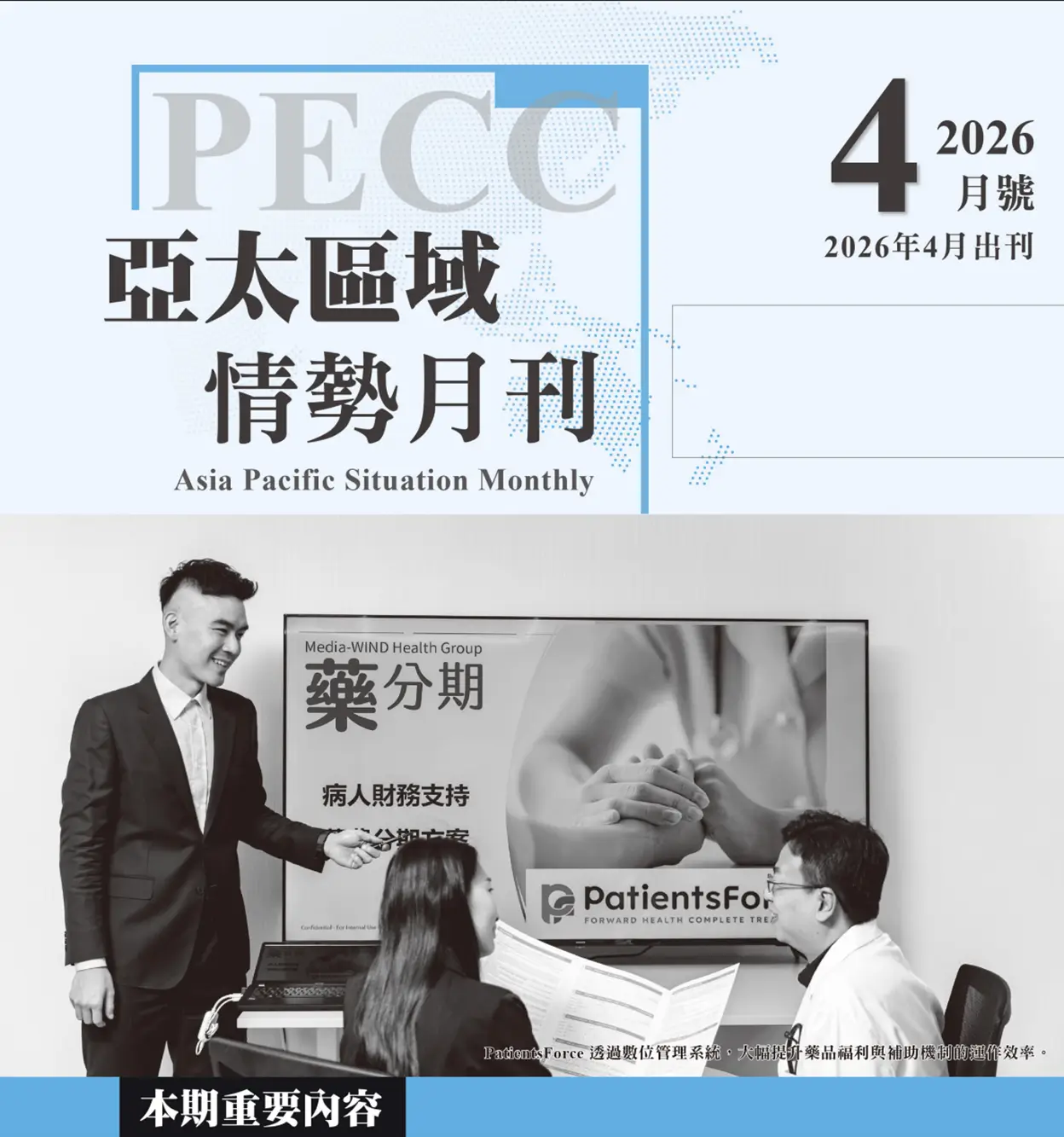
Recently, the Asia-Pacific Regional Situation Monthly Monthly published by the Pacific Economic Cooperation Council Council (CTPECC) featured an exclusive interview with PatientsForce COO Wang Yiwen. An in-depth exploration of how, in a complex institutional environment, companies can leverage digital platforms and service innovation to build comprehensive and inclusive health management systems.
The Overlooked Medical Reality: Decision-making, costs, and information gaps
COO Wang Yiwen pointed out a key observation: healthcare is not just about “seeing a doctor and prescribing medicine,” but a series of decision-making processes that require integrating information and judgment.
Take cancer treatment as an example: a single course can cost hundreds of thousands of NTD, and there are significant differences in efficacy, side effects, and financial burden between plans. However, current support resources (such as medical services, insurance claims, and social resources) often fall under different systems. After a patient is diagnosed, they often need to make major decisions in a short period of time across vast information barriers. Therefore, improving the comprehensibility and efficiency of information access has become a core key to optimizing health equity.
Building the ‘MedPass’ platform: a one-stop patient support ecosystem
Facing the challenge of cross-system service integration, PatientsForce embraces the vision of “Forward Health, Complete Treatment,” integrating previously fragmented services into a one-stop solution:
- Front-end (Health Education and Communication): Enhance public awareness and willingness to seek medical care.
- Mid-range (Patient Support PAP/PSP): Helps patients access medication resources, reduces financial burden, and is managed and followed up by professional nursing staff.
- Backend (Long-Term Care Transition): Extends to long-term care services such as patient companionship and family coordination, establishing smooth service transitions.
To implement this framework, the team developed the “MedPass” platform, which integrates highly used social media and backend management systems. Enables patients, doctors, case managers, and caregivers to interact efficiently on the platform. This digital design not only reduces the transaction costs of time and information search, but also implements paperless operations through systematic processes, realizing the value of environmental sustainability.
International governance standards and APEC health policy objectives
In governance of PSP (Patient Support Programs), PatientsForce emphasizes compliance and accountability, not only facilitating efficient linkage across different links through platform-based approaches, but also obtaining ISO international certification and PSCI supply chain initiatives, gradually enhancing system transparency and patient experience.
As the Asia-Pacific region faces challenges of population aging and rising healthcare expenditures, APEC also emphasizes enhancing healthcare resilience through digitalization and public-private collaboration. The patient support and welfare platform promoted by PatientsForce demonstrates the “filling and adding value” role the private sector can play within the public healthcare system, and is expected to become an important reference for regional inclusive growth in the future.
Want to learn more about the full interview with COO Yi-Wen Wang and how PatientsForce aligns with APEC’s health policy goals? Click the link to read the full article in the Asia-Pacific Regional Affairs: Read the full interview report