
Beyond medication: how a Patient Support Program walks with ACH families through the treatment journey
By Tzu-Han Chang, Senior Patient Relations Specialist & Health Education Counselor, Patientsforce
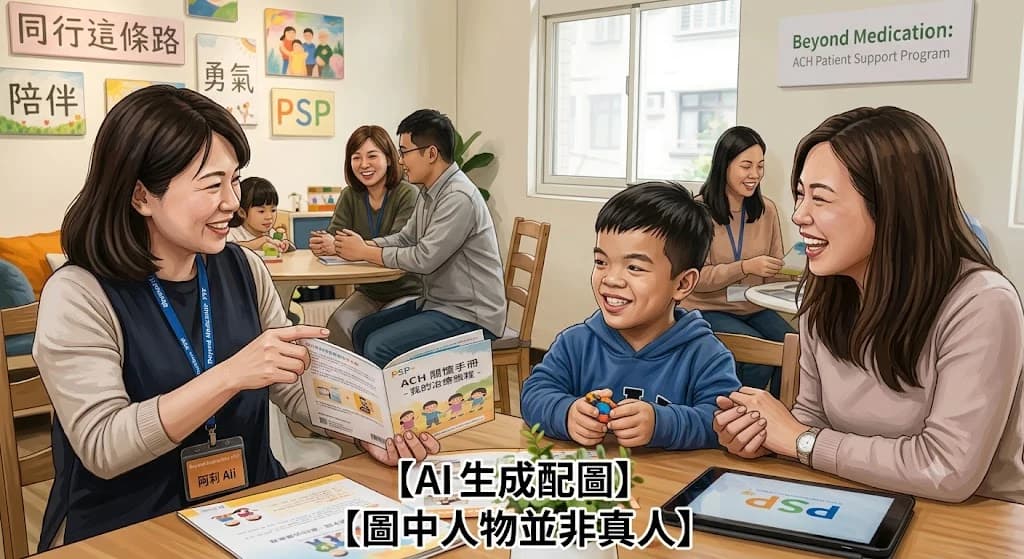
For patients with achondroplasia (ACH) and their families, long-term treatment is not simply a matter of receiving therapy on schedule. It is a care journey that requires sustained follow-up, family-wide participation, and close collaboration with the medical team.
Beyond the condition itself, families frequently face challenges around scheduling hospital visits, day-to-day care, and adapting daily life around treatment. Helping patients stay stable on treatment, and helping families build confidence in caregiving, is what a Patient Support Program (PSP) is there to work on.
PatientsForce has invested in Patient Support Programs over the long term. Our PSP educators provide continuous follow-up, professional education, care coordination and resource connection, so that support does not stop at the hospital door but extends into the daily life of the patient and the family — a care partner families can rely on through a long course of treatment.
Continuous follow-up, and a steadier treatment journey
ACH requires long-term treatment and regular monitoring. A stable treatment journey depends not only on the medical team's clinical care but on the family's sustained cooperation and support.
Since the ACH PSP began, our educators have accompanied each case and family throughout: disease and medication education in the early phase, guidance on injection technique, then regular follow-up, visit reminders and care consultation. Each proactive check-in is an opportunity to understand what the family needs at that point in treatment and to offer appropriate help without delay.
The ACH PSP has now completed a full year of follow-up. Over that period, with continuous educator support, overall compliance held at 99.87%. Every one of the 12 months reached 99.7% or above, and 5 of those months reached 100%.
Stable compliance is more than a number. It reflects families gradually establishing a regular treatment routine, and it shows the value educators add through sustained follow-up, proactive contact and timely support across long-term care.
Real-world feedback: change beyond the treatment itself
Alongside compliance tracking, our educators regularly gather families' observations from everyday life, in order to understand more fully how patients are doing through the treatment journey.
Among cases followed for six months or more, families reported not only on growth but — more often — on gains in daily living skills and participation in activity.
One child who had needed to stand on a small stool to reach the washbasin can now complete daily washing independently. Another, who used to need help opening doors and operating taps, has gradually become able to manage these things alone.
Some parents also observed a steadier gait, improved capacity for activity and less fatigue, along with greater willingness to join outdoor and school activities. On fine motor skills, parents described a steadier pencil grip, a clear increase in willingness to learn and interact with peers, and growing confidence.
These changes may not all show up fully in clinical data, but they are happening in the daily life of patients and families — and they help the care team see the value of long-term support for a patient's overall development and quality of life.
The observations above are records shared by individual families about their everyday lives. They are not clinical trial results and are not an efficacy claim for any medicine. Disease presentation and response to treatment vary between individuals; the appropriate treatment, its expected outcomes and its possible risks should be explained and determined by the treating physician on the basis of each patient's clinical assessment.
Listening first, then building the service around it
The value of a Patient Support Program lies not only in delivering the services already defined, but in using long-term contact to understand what families actually need through the care journey — and then improving the support accordingly.
Across the first year, our educators found that beyond clinical care itself, cross-county hospital visits, travel time, arranging a caregiver to accompany the patient, and transport cost were persistent challenges for many families. Drawing on that front-line experience, PatientsForce expanded a transport subsidy support service this year, to reduce the access barrier transport creates and help patients complete long-term treatment more smoothly.
Educators also noticed that because the medicine must be stored properly during treatment, families worried about storage and transport when travelling home, moving between counties, or going abroad. In response, PatientsForce introduced a portable cold-storage bag service, giving families a more convenient and reassuring way to carry medication — so that going home, travelling or simply being out for the day does not put continuity of treatment at risk.
Finding needs through every follow-up and every conversation, and turning front-line feedback into services that sit closer to the patient, is the core of how PatientsForce runs Patient Support Programs.
Patient Support Program: alongside every stage of the journey
Looking back on the first year of the ACH PSP, what we see is not only compliance holding steady, but change and growth in patients and families across a long treatment journey.
With continuous educator support, parents have built caregiving confidence, children have more opportunity to participate in life and social interaction, and the relationship between medical team and family has become a closer collaboration built on trust.
We believe a Patient Support Program's value is not only in supporting treatment. It is in supporting every family.
Ahead, we will continue to connect patients, families and medical teams through professional educator support, cross-team collaboration and resource integration — building a more complete model of care that sits closer to real needs, extends support from the hospital into daily life, and helps every family walk each step of long-term care with more confidence.
If you are a healthcare professional wanting to understand how a support program could help your patient, enquiries are welcome by physician referral.