
Breaking the EAP regulatory barrier: a cross-border procurement case for a controlled medicine
Case Report | April Li, Associate Director, Early Access, PatientsForce
A child with persistent dystonia and severely raised intracranial pressure. The clinical assessment was unambiguous: if the pressure stayed where it was, an intracranial haemorrhage could come at any time.
The medicine he needed was not rare. The dosage form was. He could not swallow solid tablets, so his physician needed a liquid drop formulation to titrate the dose precisely — too much would not do, too little would not hold the pressure down. And those clonazepam oral drops were not on the formulary of any hospital in the country.
So treatment stopped at step one. Not because the medicine did not exist, but because nobody could bring it in.
For the family, waiting was never just an administrative process. It was facing, every single day, the question of whether today would be the day. It was the accumulated physical and mental cost of long-term care. And it was the distance and misunderstanding that come from people around you not grasping what is wrong with your child.
One liquid formulation, stuck between three countries' paperwork
Hospital pharmacy management is built to favour high-turnover, economically scaled stock. That lean design keeps day-to-day waste low. The cost of it shows up exactly here: when a patient needs a low-turnover, highly specific dosage form, the system simply stops.
And importing an internationally controlled medicine under an Expanded Access Program (EAP) is not cross-border online shopping. It is a compliance exercise across three parties: the domestic food and drug regulator, the international controlled-substances monitoring body, and the regulator of the exporting country.
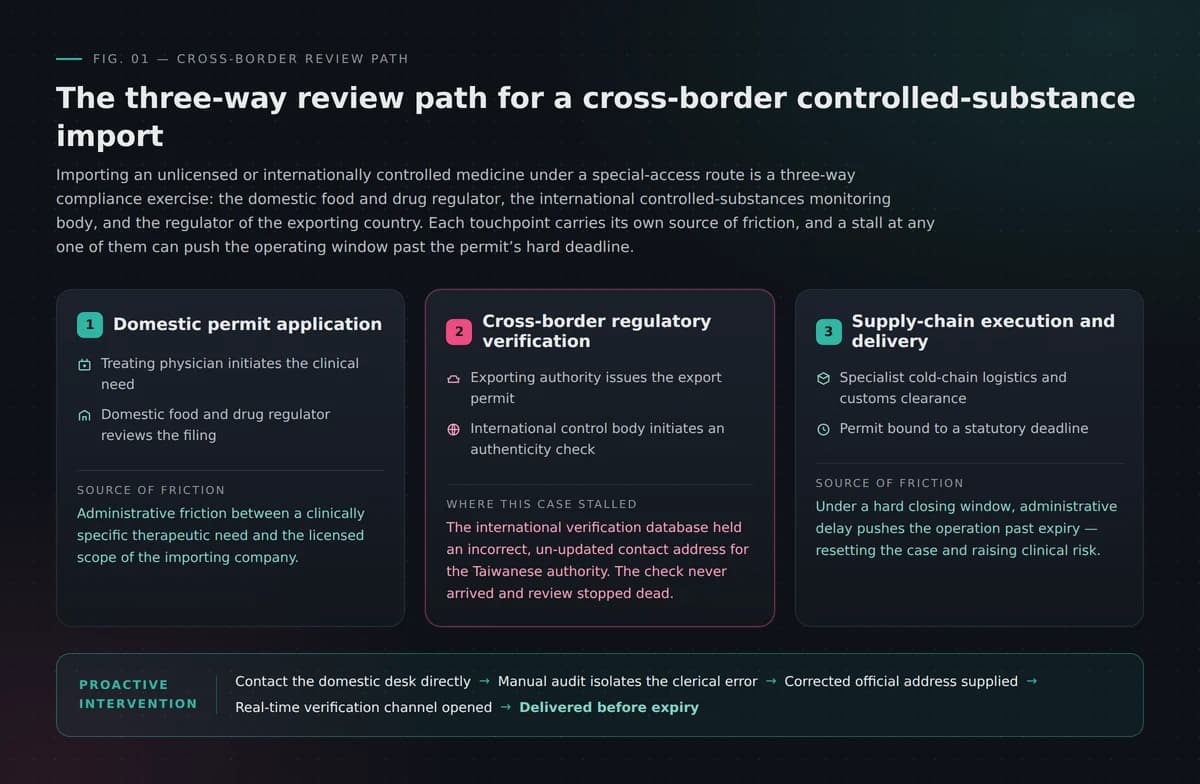
Three stages, each with its own friction. Domestically, a clinically specific need has to be aligned with the licensed scope of an importing company. At the border, an international authenticity check has to clear. At delivery, one thing is not negotiable: the permit's statutory expiry date.
That last point carries the weight of the whole case. Import permits run on hard deadlines. If information stalls anywhere in the chain, the operating window slides past the line and the case resets. For the institution that is administrative cost. For this child it means carrying the risk in his skull for another few months.
What stalled was not the medicine. It was a letter sent to the wrong address
When the overseas supplier applied to its own authority for an export permit — the first export route of its kind to Taiwan — international procedure required an official authenticity check to be raised with the Taiwanese authority through the International Narcotics Control Board (INCB).
It was the first time that bilateral channel had been used. And it broke.
Running the check, the international body used the Taiwanese contact email address recorded in its database. That address was wrong, and had never been updated. The message could not arrive. Nothing reached the Taiwanese side. Cross-border review came to a complete standstill.
A clerical error. And the deadline kept moving.
The intervention: call the desk directly
"We did not wait for the international administrative process to correct itself. We contacted the responsible desk at the Taiwan Food and Drug Administration (TFDA) directly," says April Li.
After multi-party liaison and a segment-by-segment manual reconciliation, the team found the lesion quickly: the Taiwanese official email address held in the INCB system contained a clerical error.
What followed was simple — and would not have happened if nobody had done it. The team supplied the corrected, legally valid official address to the international body, letting the Taiwanese authority and the international regulator open a direct, real-time channel for digital verification. The barrier cleared, and the import permit continued lawfully ahead of the hard deadline.
This is what our EAP work keeps confirming. The most effective variable for compressing time-to-treatment is not tracking the shipment more diligently. It is intervening at the regulatory touchpoint that is actually stuck.
Private insurance stepping in: so one family does not carry the whole cost
Most patients receiving overseas special-access medicines pay out of pocket. Because the import is supplied through the hospital, private insurance can step in, supporting the patient along the search for treatment and easing the financial burden.
Working towards the same goal — keeping the cost off any single family — combining the needs of several families and clinical units facing the same shortage had concrete effects too. Consolidating highly sensitive international cold-chain shipping and customs fees sharply reduced the marginal cost falling on any single patient. Integrated regulatory filing removed the administrative hours of re-submitting permits one by one. And the institution was able to bring in a scarce medicine without committing significant working capital, and without inventory risk.
For decision-makers this is not only humanitarian practice. Every avoidable stall in a supply chain is frozen managed capital and eroded clinical credibility.
In July, the medicine arrived
The shipment reached the domestic institution in July and was formally released for clinical use.
The patient's raised intracranial pressure and dystonia stabilised quickly, and the risk of sudden intracranial haemorrhage was cut off. And a family that had carried both misunderstanding and psychological strain along a hard care journey finally felt a professional system standing on their side.
Making the route repeatable
A success that is only luck is worth nothing. Three things make this path reproducible.
- Proactive regulatory tracking: drop the passive shipment-tracking mindset. Staff the process with project managers capable of cross-border communication, who actively audit whether information between the international body and the domestic authority is genuinely moving.
- Active maintenance of the global compliance contact matrix: periodically verify the official contact details held for your institution or partner importer in international regulators' databases, INCB included, so that the kind of clerical error seen here cannot stall a case at source.
- Demand aggregation and logistics pre-vetting: build compliant pooled self-pay frameworks for high-cost, low-turnover niche medicines, and complete compliance pre-vetting of import routes with cold-chain partners qualified for controlled substances — rather than starting the search once acute need has already arrived.
When routine channels cannot catch a patient because of market or institutional limits, specialist pharmaceutical consultancy and logistics coordination are the only bridge between that patient and a chance at survival.
The special import described here was filed by a pharmaceutical company holding a valid licence and approved by the competent authority. Whether a specific therapy is appropriate for an individual patient is a judgement for the treating physician on clinical assessment; special-access enquiries are welcome by physician referral.