
The scorecard patients hold: what 2,403 patient groups say about pharma, and how Asia and Taiwan are moving
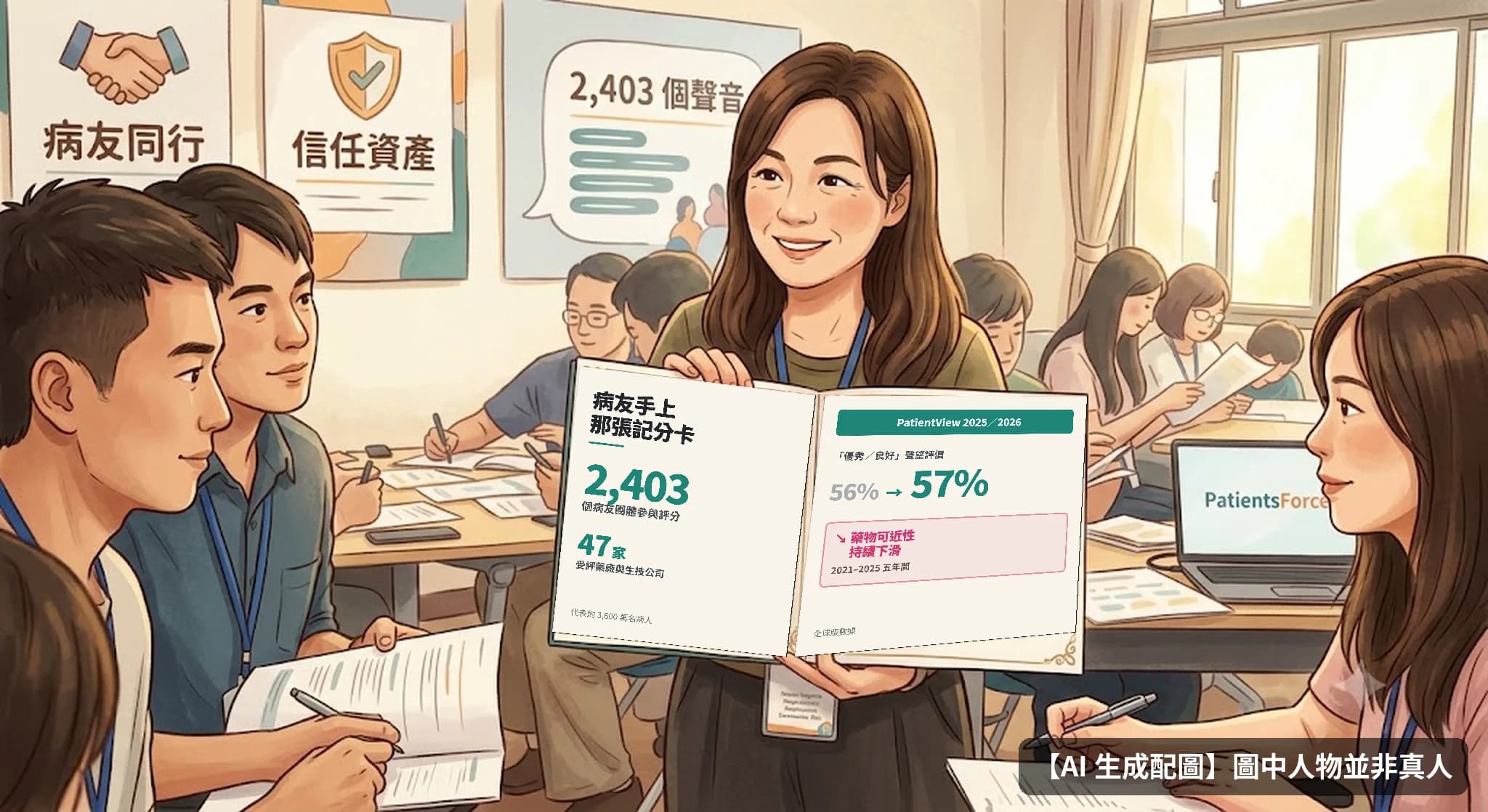
Now in its 15th year, PatientView's global Corporate Reputation of Pharma report is taken seriously in boardrooms across Europe and the US.
The reason is simple. This is third-party assessment that pharma did not pay for, did not write, and did not have a consultancy assemble from case studies. And the people holding the scorecard are precisely the constituency pharma most exists to serve, yet most often overlooks in the decision meeting: patient groups.
PatientView global snapshot
Figures below are from PatientView's Corporate Reputation of Pharma 2025/2026 — Global Edition, published April 2026:
- Patient groups surveyed: 2,403, spanning 48 therapy areas, with fieldwork conducted in 23 languages.
- Patients represented: approximately 36 million.
- Companies rated: 47 international pharmaceutical and biotech companies, of which 15 sit in the big-pharma sub-ranking.
- The 10 indicators: patient centricity, patient information, patient safety, product benefit to patients, transparency on pricing and clinical-trial data and stakeholder funding, integrity, quality of patient-group relations, services beyond the pill, patient engagement in R&D, and equitable access to medicines.
Third-party performance assessment that cannot be waved away
PatientView is an independent UK-based research and consultancy firm, founded more than 20 years ago, with a global network covering over 40,000 patient groups. Three structural features are what keep the research from sliding into public relations:
- Funding independence: the study is self-funded end to end and accepts no pharmaceutical sponsorship for it.
- No quid pro quo: patient groups are surveyed free of charge and receive the report free of charge, removing the mechanism by which favourable scores could be bought.
- Consistent indicators: the same 10 indicators for 15 consecutive years, leaving regression and short-termism nowhere to hide.
Those 10 indicators effectively constitute the core of the twenty-first-century pharmaceutical social contract — from the basics of education and safety through to the harder questions of pricing transparency, integrity and partnership.
Five signals worth reading closely
Five things stand out in the latest data.
1. Overall reputation edged up, while access to medicines kept sliding
The share of patient groups rating pharma's reputation "excellent" or "good" rose from 56% the previous year to 57%. Yet PatientView's thematic analysis notes that across 2021 to 2025 the industry slipped — modestly but persistently — on ensuring patient access to medicines. Patient groups consistently rank access as their single highest-priority concern. The small rise in the headline score is, in effect, covering the one line that most deserves attention.
2. Violent ranking volatility is the new normal
This year's table moved sharply in both directions. The drivers are US policy upheaval (IRA price negotiation and the One Big Beautiful Bill Act), the patent cliff, and the organisational contraction and layoffs that follow pipeline setbacks. For reputation management the implication is that a ranking is no longer a stable asset — it has to be re-earned every year.
3. The immediate cost of cutting patient-group budgets
The report puts an open industry secret on the record: when a company hits operating headwinds, the patient-group relationship budget is usually the first thing cut. The data is blunt about the consequence — companies that reduced patient-group relationships in a given year were marked down the following year. The budget saved costs far more than the trust lost.
4. The agility of smaller biotechs
Smaller biotech companies newly entering the ranking — Alnylam, Sobi, Crinetics, Regeneron and Jazz among them, most focused on rare disease — scored very highly. Patient groups were direct about why: these companies decide quickly, run flat structures, give direct access to leadership, and are not slowed by bureaucracy.
5. The method behind ViiV's 13 consecutive years at the top
ViiV Healthcare again led the overall table, ranked first by patient groups for the 13th successive year; Roche/Genentech/Chugai led the big-pharma sub-ranking. The core of ViiV's approach is sustained: patient groups are built into every stage of the product life cycle, from early research through post-marketing surveillance. It is now the template other companies are asked to benchmark against.
The Asia-Pacific view: three contradictions
The Asia-Pacific figures below come from PatientView's Asia-Pacific regional reporting. That is a separate publication from the global edition, with a different sample structure and survey year, so cite the version alongside the number.
Contradiction one: high overall satisfaction, deep dissatisfaction on fair pricing
Only around 16% of Asia-Pacific patient groups rate pharma as excellent or good on fair pricing. Asian patient groups are appreciative of the health improvement medicines deliver, yet hold strong distrust of pricing logic — a contrast rarely this sharp in Western markets.
Contradiction two: China's twin peaks of high collaboration and high demands
Among Chinese respondent groups, 87% report substantive collaboration with pharmaceutical companies and 80% give a positive overall reputation rating, both markedly above the global average. The same respondents are equally explicit about three demands: deeper involvement in R&D, more reasonable pricing, and greater transparency.
Contradiction three: the patient-group role has moved on; pharma's engagement model has not
More than 70% of Asia-Pacific patient groups consider themselves to have real influence over the health system, and over half already represent patients directly to regulators. Yet most multinationals' engagement model in the region remains within the traditional one-way repertoire of sponsoring education events or inviting a patient to speak.
Taiwan: three blind spots behind the good news
International coverage of PatientView's regional reporting has identified Taiwan as one of the few markets where pharma's reputation rose sharply against the global trend, with satisfaction up more than 10 percentage points — alongside the Netherlands, Denmark and Sweden.
Behind that sit the National Health Insurance Administration's moves on temporary payment and parallel review, and sustained investment by several companies in rare-disease and oncology PAP/PSP programmes. But three blind spots deserve attention.
Blind spot one: the score comes from specific companies, not structural maturity
Taiwan's strong score is lifted mainly by a handful of companies deeply invested in rare disease and oncology. In other therapy areas, patient-group interaction remains a sponsorship relationship rather than a partnership. An industry average pulled up by a few strong performers is not the same as improved industry health.
Blind spot two: pricing transparency is unexploded ordnance
Pricing transparency has almost never had a rational public discussion in Taiwan. The trust deficit created by opacity around confidential discounts, managed-entry agreements and cost subsidy is the next hazard for corporate reputation here.
Blind spot three: the localisation question nobody wants to open
The Edelman Trust Barometer warns that Asia-Pacific markets generally trust domestically headquartered companies more than foreign-headquartered ones. For multinationals operating in Taiwan, a global brand halo does not convert automatically into local trust; local accountability and local partnership have to be implemented in substance.
Four actions for reputation teams in Taiwan
Combining PatientView's data with what we see in the market, we would put four items in front of a decision team:
- Reposition PAP/PSP from cost centre to reputation engine. Under budget pressure, patient-community services should be the last thing cut, not the first. PAP/PSP is not a discretionary line in a commercial budget; it is the company's most important long-term trust asset in the patient community.
- Make access to medicines measurable and visible. What patient groups want is not an abstract slogan but concrete numbers: applications received, approval rate, average waiting days, and the gap still unmet. A company that builds and regularly publishes an access dashboard creates a trust barrier competitors cannot easily clear.
- Move from consulting to co-creating. Following the example of the perennial leader, bring patient groups in at the point where the questions and the programme are being defined. That is where the reputation gap actually opens up.
- Lead with transparency. Faced with community doubt about pricing and where resources go, the communication cost of demonstrating transparency is far lower than the cost of repair after reputation collapses.
Reputation is not a communications problem; it is a service-delivery problem
Our front-line experience running PAP/PSP programmes with international pharmaceutical companies in Taiwan keeps confirming the same thing: a company's reputation is not written by its communications function. It is delivered by its service.
When a patient's treatment journey and PAP application run smoothly, when the cost estimate is clear and reasonable, when a case manager is there at the moment it matters, and when adherence holds at a high level, the trust that patient — and the patient group behind them — forms towards the company runs deeper and lasts longer than any CSR campaign.
Principal sources
PatientView, Corporate Reputation of Pharma 2025/2026 — Global Edition press release (April 2026); PatientView Asia-Pacific regional reporting; ViiV Healthcare press release (April 2026); STAT News, 5 May 2026; related Fierce Pharma coverage; and the Edelman Trust Barometer global and Asia-Pacific reports. Figures should be read against the original reports; Asia-Pacific and Taiwan data come from regional publications whose sample structure differs from the global edition.