
The next step for patient support programs in Taiwan, 2026
By Nerrisa Kuo, Director at PatientsForce
From service delivery to a value- and outcome-driven medical platform
The patient support program (PSP) market has grown rapidly in Taiwan over recent years. Looking back from 2026, the nature of PSP has fundamentally changed. It is no longer merely 'patient care services' — reminders, education follow-up or a call center — but the watershed into the era of value-based care.
What makes a PSP competitive is no longer how many services it offers, but whether it measurably improves patient outcomes, raises the efficiency of care, and creates quantifiable value for the health system.
PSP is being redefined
Globally, PSP has been upgraded from a support function to a core component of pharma strategy. Especially in oncology, rare disease, autoimmune disease and specialty care, PSP now directly affects:
- Speed of treatment initiation
- Persistence on therapy
- Discontinuation and attrition rates
- Clinical outcome tracking
- Patient quality of life (QoL)
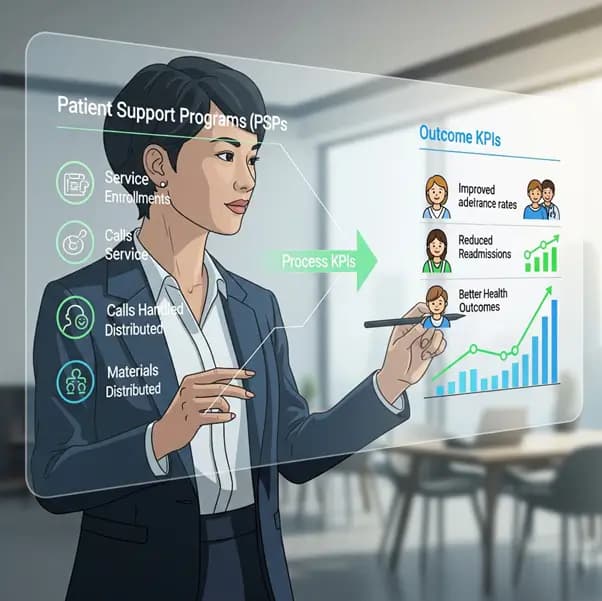
Pharma once evaluated PSPs by service volume — call counts, contact frequency, satisfaction. What the market now cares about is whether the PSP truly improves outcomes. For example:
- Does 3-month persistence improve?
- Do follow-up visit rates improve?
- Do hospitalizations and ER visits fall?
- Are adverse events detected earlier?
This shift from process KPIs to outcome KPIs will rewrite how PSPs are designed.
AI as the biggest engine of the PSP upgrade
Another key 2026 trend: AI is entering the patient support workflow fast. AI's role in PSP is not to replace people but to redistribute the value of professional staff. Low-risk, standardized tasks can be AI-assisted:
- Initial symptom triage
- Medication reminders
- Appointment booking
- FAQ education
- Emotional-risk early warning
High-risk patients, complex regimens and psychological support remain the deep work of professional nurses and case management teams. This is not just efficiency — it is care model redesign. Amid ongoing healthcare workforce shortages, it will be the most important capability of the next three years.
Taiwan's next PSP stage is not in the hospital but in the patient's home
Taiwan enjoys a highly accessible NHI system, but faces aging, chronic-disease burden and workforce pressure. The most important direction for PSP is the move from hospital-based support to home-based continuous care.
Especially in oncology and specialty medication, the real challenges patients face are rarely in the consulting room — they come after going home:
- Side-effect management
- Regimen adherence
- Caregiver strain
- Emotional and anxiety support
- Remote monitoring of physiological data
This is where PatientsForce has been investing: extending patient support from the hospital into everyday life.
PSP as the key to real-world evidence
The future value of PSP goes well beyond services: it becomes a generation platform for real-world data (RWD) and real-world evidence (RWE). Through genuine interactions along the patient journey, it continuously accumulates persistence rates, adverse-reaction patterns, symptom burden, patient-reported outcomes and quality-of-life measures.
Such data matters for care itself, and supports HTA, reimbursement negotiation, HEOR, market access strategy and lifecycle evidence generation.
Whoever can prove with data that they genuinely improve patient outcomes — higher persistence, lower hospitalization, better experience, better health-economic results — wins.
PSP will be more than an extension of medical services. It will be the most important value platform connecting patients, pharma, providers and digital technology — and the transformation most worth watching in the next stage of Taiwan's healthcare industry.
Sources: IQVIA (2026), Four Forces Reshaping Patient Support in 2026; Deloitte (2026), The 2026 Global Health Care Outlook; WTW (2026), Global Medical Trends Survey Report — Asia Pacific Insights; Taiwan Ministry of Health and Welfare (2025), amended NHI Home-based Acute Care Pilot Program; National Science and Technology Council (2025), Home Healthcare Technology Vision and Action.