
Clinical trials: guinea pig or lifeline? Unpacking free and subsidized routes to treatment
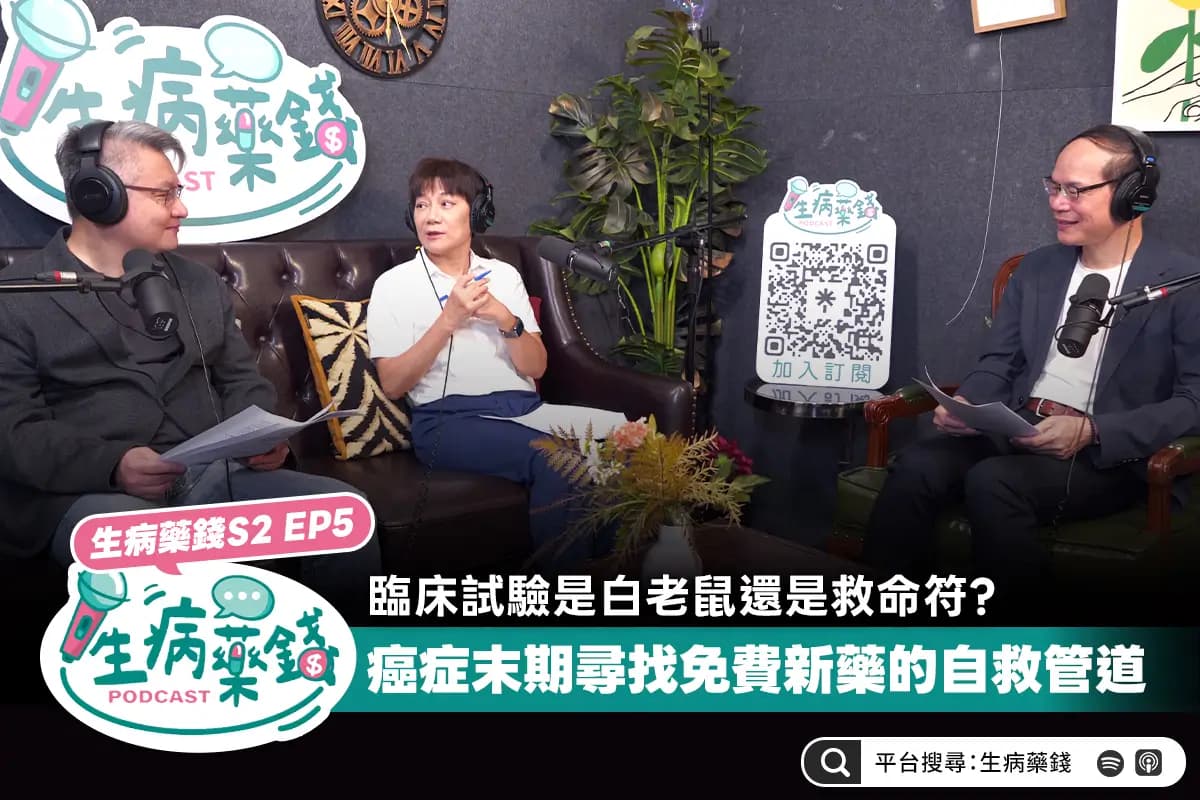
When physicians declare standard treatment exhausted and time is running out, critically ill patients and families face a double blow: the illness itself, and a breath-taking self-pay bill that can run to millions of NT dollars a year. In the precision-medicine era, costly targeted and immune therapies bring hope of cure — and towering financial thresholds.
What many don't know is that pharmaceutical companies, in order to accumulate clinical experience, offer several legitimate channels for free medicines or financial assistance. This episode welcomes Alan Cheng, CEO of IUSEA biotech consultancy with nearly 30 years as a multinational pharma executive, to unpack four legitimate self-help resources from an insider's perspective.
1. A license is not reimbursement: the 'time gap' of high-cost new medicines
Patients often ask: 'The drug is launched in Taiwan — why must I still pay in full?'
Alan explains a key distinction: obtaining a drug license (market approval) and obtaining NHI reimbursement are entirely parallel matters. TFDA approves launch, confirming safety and efficacy; the National Health Insurance Administration assesses affordability and inclusion in public coverage.
A new drug takes 10-20 years to develop. Passing TFDA review merely means it can be legally sold in Taiwan. The NHIA, weighing fiscal burden, typically needs 1 to 1.5 years for health-economic review and price negotiation. That institutional gap of several hundred days is the financial black hole in which patients pay millions per year out of pocket.
2. The guinea-pig myth: what insiders know about screening and safety
When an attending physician suggests joining a clinical trial, most patients recoil at being a 'lab rat'. Clinically, however, a trial is often the lifeline when no drug remains.
Trials have extremely strict inclusion and exclusion criteria. 'The patient doesn't choose the trial — the trial's scientific specifications choose you.' Only patients matching specific mutations and pathological markers are invited, and they enjoy three protections:
- Free, top-tier care throughout: the sponsor covers the drug and even precision testing, greatly easing financial pressure.
- Tight safety monitoring: the trial is doubly supervised by the hospital IRB and TFDA; if side effects emerge, the team immediately triggers discontinuation and care mechanisms.
- The head-to-head opportunity: when a market leader exists as an expensive self-pay drug, the maker of a similar second entrant will run head-to-head trials to save time — giving patients a strong chance of free treatment comparable to the top self-pay option.
3. No trial available? The dual rescue of early access and compassionate use
If no trial is running in Taiwan, or time has run out, two often-confused but crucial regulatory routes remain:
Early Access Program
A company-driven global program: when a drug has proven outstanding efficacy in Phase II/III and is applying for licensure, the maker proactively releases quotas worldwide, providing the medicine free to critical patients so clinicians gain experience early.
Compassionate Use
A humanitarian rescue initiated by patient need and the attending physician. When no effective domestic option remains but a drug is launched or in trials abroad, the physician applies through the hospital IRB and TFDA to request case-by-case supply from the foreign maker. It is discretionary — companies are not obliged — and usually happens at major medical centers.
4. 'Buy two get two' is not a sale: the social responsibility of patient support programs
If a drug is launched but not yet reimbursed and the above programs don't fit, ask the attending physician whether it has a patient support program (PAP).
Out of corporate social responsibility and to sustain long-term adherence, companies design packages by national income level. In Taiwan, they run programs through independent third-party medical service organizations. A common form is financial gifting — the familiar 'buy two get two' or 'buy a course, get a course' — cutting an annual cost of a million NT dollars to half a million and greatly improving access.
5. Taiwan's shrinking trial pipeline: three concrete self-help steps
Per the latest IQVIA data, Taiwan hosted only 372 clinical trials in 2024 — declining yearly and trailing South Korea (510) and Japan (392). Facing shrinking resources, Alan advises:
- Search national resources proactively: the government's Taiwan Clinical Trials portal lists which hospitals are recruiting for which diseases.
- Assess risk rationally with your physician: a Phase III trial means safety has passed initial verification; with manageable side effects, seize the chance.
- Seek second opinions at major medical centers: early access, compassionate use and PAP resources concentrate there; referral for multidisciplinary assessment is advisable.
Love is the best medicine, but health literacy is love's armor. Facing critical illness, panic solves nothing. Understand the rules of drug access and communicate proactively with the care team, so that at the crucial moment you can mobilize industry and government resources and clothe your family in the strongest financial armor.